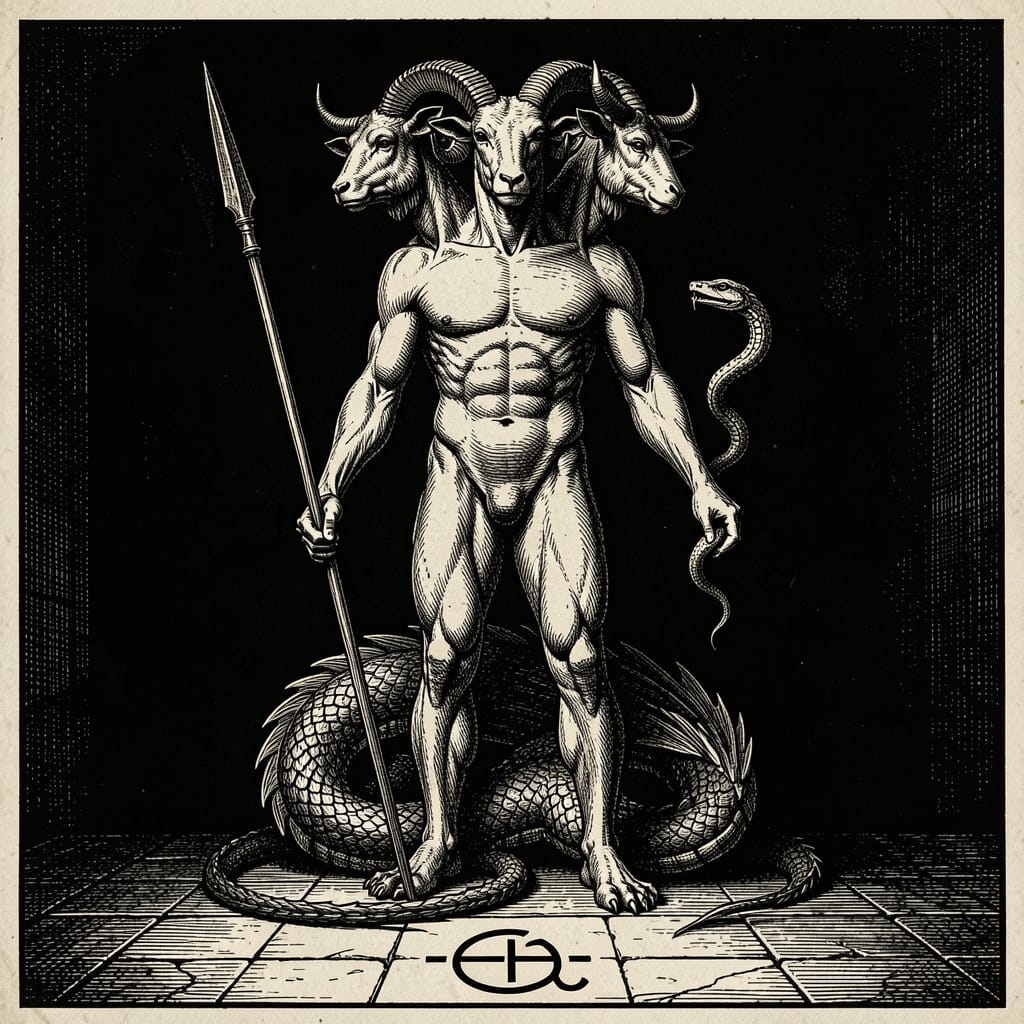
Asmodeus enters scripture in the Book of Tobit (c. second century BCE). Sarah, daughter of Raguel, has been married seven times, and on each wedding night Asmodeus — who desires her, and will let no husband possess her — slays the bridegroom before the marriage can be consummated. When the young Tobias comes to marry her, the archangel Raphael instructs him: he burns the heart and liver of a fish on the embers, and the smoke drives Asmodeus away to Egypt, where Raphael binds him. It is one of the oldest exorcism narratives in the biblical tradition, and it fixes Asmodeus forever as the enemy of marriage and the destroyer of the marriage-bed.
The Testament of Solomon, a later pseudepigraphical text, gives him his second great story. Summoned before King Solomon by the power of a ring bearing the Seal of God, Asmodeus is compelled to confess his nature — that he plots against newlyweds, spreads madness of desire, and works to undo the happiness of the married — and is then forced to labour on the building of the Temple. In the Talmudic legends he is Ashmedai, king of the shedim (spirits): a more ambiguous, sometimes almost genial figure, who nonetheless tricks Solomon, seizes his throne, and reigns in his place for a time before the king returns.
In the grimoire tradition Asmodeus becomes a Great King of Hell. The Ars Goetia lists him as the thirty-second spirit, commanding seventy-two legions, appearing with three heads — one of a bull, one of a man, one of a ram — with the tail of a serpent, riding a dragon and breathing fire. He teaches geometry, arithmetic, astronomy, and the handicrafts, and reveals the location of hidden treasure. In Binsfeld's 1589 classification he is the demon of Luxuria — Lust — and the Malleus Maleficarum names him the same.
Across every version, one thread holds constant: Asmodeus is the specific enemy of the marriage-bond and the union of husband and wife. In Tobit he murders to prevent consummation; in the Testament of Solomon he confesses that his work is to estrange the married and drive newlyweds apart; in the Talmud his desires turn upon Solomon's wives and Bathsheba. His lust is never presented as mere appetite but as something that destroys — that will not permit love to be completed in another, and will kill before it allows it.
This is what makes him the demon of Luxuria in its gravest sense: not desire as pleasure, but desire as the corruption and destruction of the bonds it should serve. The smoke of a fish's heart drives him off in Tobit, but he is never destroyed — only bound, only removed, always waiting to return to the threshold of the bridal chamber.